
Meta Will Charge for WhatsApp Service Messages from October 1, 2026: What It Means
Starting October 1, 2026, Meta will charge for WhatsApp Business API service replies inside the 24-hour window. Here is the simple explanation, what stays free, and how Wabery will pass the new fee through with no markup.
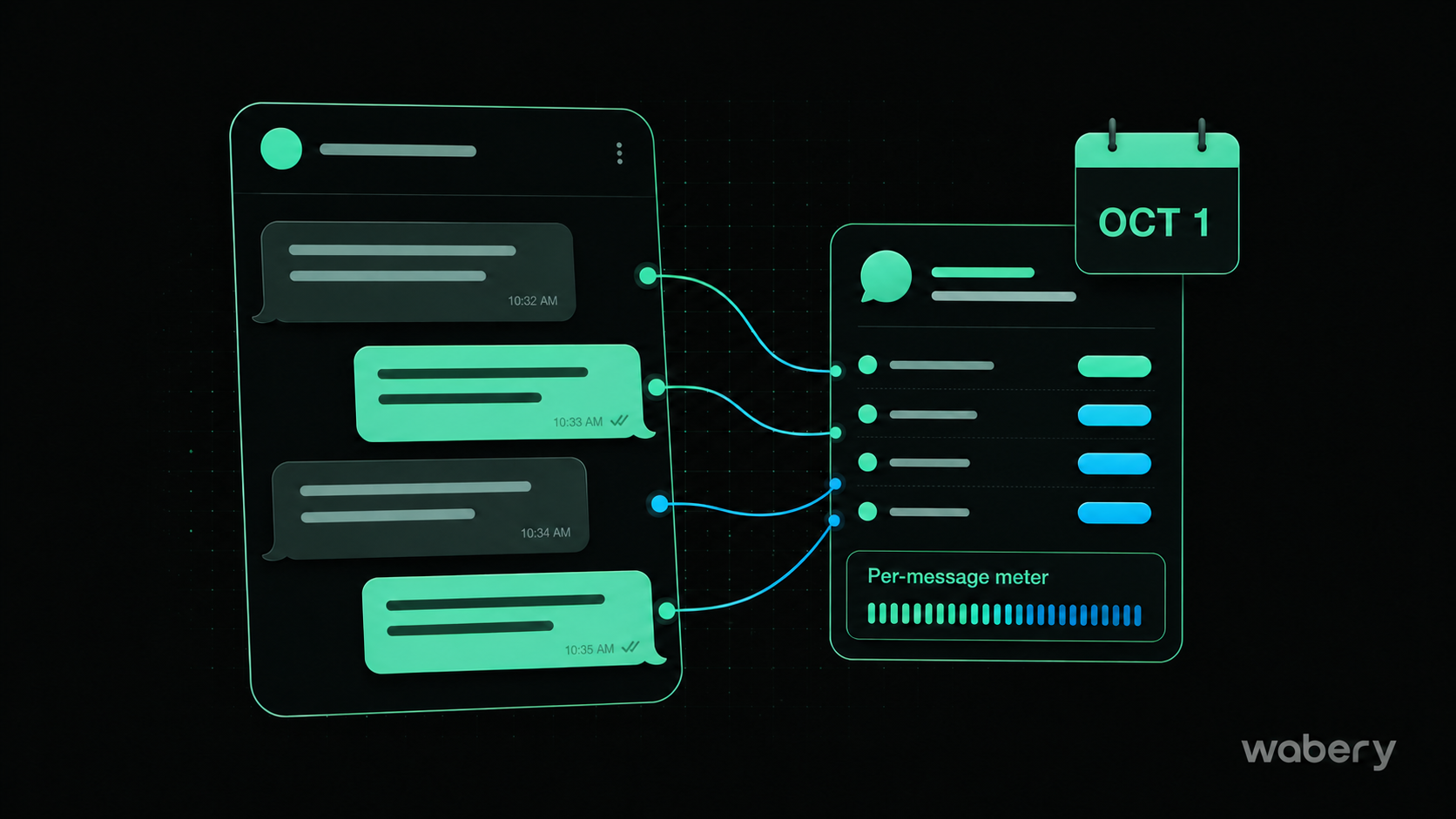
Until now, one of the nicest things about WhatsApp Business API pricing was simple: when a customer messaged you first, your replies during the next 24 hours had no Meta messaging fee.
That changes on October 1, 2026.
Meta will start charging for each delivered service message a business sends inside that 24-hour customer service window. In everyday language, that means a normal reply such as “Yes, we have an appointment at 3 PM” will become a paid Meta message when it is sent through the WhatsApp Business Platform.
This affects Wabery and every other provider built on the official WhatsApp Business API. It is a Meta fee, not a new rule invented by Wabery.
The short answer
Here is the whole update in one table:
| Message | Until September 30, 2026 | From October 1, 2026 |
|---|---|---|
| Customer messages your business | No Meta messaging fee | No Meta messaging fee |
| You send a normal reply inside 24 hours | No Meta messaging fee | Meta charges per delivered message |
| You send a utility template inside 24 hours | No Meta messaging fee | Meta charges per delivered message |
| Marketing or authentication template | Already charged | Still charged |
| Messages in an eligible 72-hour ad entry window | Free from Meta | Still free from Meta |
The official WhatsApp Business Platform pricing documentation describes the new billing model. Meta partners have also published notices with the same October 1 date, including Twilio’s pricing update and Alibaba Cloud’s service-message billing notice.
What is a WhatsApp service message?
“Service message” sounds technical. It is not.
A service message is a normal, non-template reply your business sends after a customer messages you. It can be written by a person or sent automatically by an integration or purpose-built AI assistant.
Imagine this exchange:
- Customer: “Do you have any appointments on Friday?”
- Your business: “Yes, we have 10 AM and 3 PM.”
- Customer: “Can I take 3 PM?”
- Your business: “Absolutely. What name should I use?”
The customer’s two messages do not create a Meta service-message charge. Your business sent two replies, so from October 1 those two delivered replies will count as two billable service messages.
The important word is delivered. Meta’s pricing is based on business-sent messages that reach the customer, not on how many 24-hour conversations you open.
Is this the Meta Business Agent charge?
No. Meta announced two different pricing changes close together:
- August 1, 2026: Meta starts separate, token-based billing for messages handled by its own Meta Business Agent product.
- October 1, 2026: Meta starts per-message billing for ordinary service replies sent by people, automations, and third-party AI systems through the WhatsApp Business Platform.
Wabery is not Meta Business Agent. The change that directly affects messages sent through Wabery is the October 1 service-message fee.
Is the 24-hour window going away?
No. The window still matters; its job is changing.
When a customer messages your business, a 24-hour customer service window opens. During that window you may send ordinary, free-form replies. After it closes, you still need an approved template to contact the customer.
Before October 1, the window answers two questions:
- Are you allowed to send a normal reply?
- Does Meta charge for that normal reply?
From October 1, it mainly answers the first question. You can still send the reply, but Meta will charge for each delivered service message.
If you want the full rule without the jargon, read our plain-English guide to the WhatsApp 24-hour window.
Utility messages inside the window will change too
There is a second change on the same day.
Utility templates are practical updates connected to something a customer has done, such as:
- Appointment confirmations and reminders.
- Order confirmations.
- Shipping updates.
- Receipts and payment notifications.
Since July 1, 2025, Meta has not charged its messaging fee when a utility template is delivered inside an open 24-hour customer service window. Starting October 1, 2026, those utility messages will be charged per delivered message too.
Utility messages outside the window are already billable, so that part is not new.
How much will a service message cost?
As of July 29, 2026, the final October rate card has not been published. Meta says it will publish the rates taking effect on October 1 by September 1, 2026.
What Meta has confirmed so far:
- The price will vary by the customer’s country or market.
- Service-message rates will match the utility and authentication rates for that market.
- Each delivered business message is a separate charge.
- Service messages will not receive volume-tier discounts.
So if you see an article claiming one exact worldwide price today, be careful. There is no single global rate, and the final October rate card is not available yet.
The simple cost formula will be:
Delivered service replies × Meta’s service-message rate for the customer’s market
We will update this article and our live WhatsApp pricing page when Meta publishes the final numbers.
What is not changing?
This is a meaningful price change, but it does not make every WhatsApp message paid.
Customers can still message you without a Meta messaging fee
The new service charge applies when the business sends a message. A customer sending “Hi, are you open?” is not a billable Meta service message.
The 72-hour free entry window remains
When someone starts a conversation through an eligible Click-to-WhatsApp ad or Facebook Page call-to-action button, and your business replies within the required time, Meta opens a 72-hour free entry window. Message delivery during that eligible window remains free from Meta under the announced update.
Advertising costs and your messaging provider’s own fees are separate.
Marketing and authentication pricing is not newly affected
Marketing templates and authentication templates are already billed per delivered message. The October update is important because it reaches the ordinary support replies and in-window utility updates that businesses have treated as the free part of the API.
The rule applies across official API providers
Moving from one official WhatsApp API provider to another does not remove Meta’s fee. Every provider using the official platform has to account for it. The useful comparison is whether a provider passes the fee through honestly or adds a markup.
What Wabery customers will pay
Wabery will update its WhatsApp rate card when Meta publishes the final October rates. The new Meta service-message fee will be passed through at cost, with zero markup.
That means:
- We will not add a percentage to Meta’s service-message rate.
- We will not hide the change inside a more expensive plan.
- Your wallet history will continue to show message charges and adjustments.
- Our documented rate card and the rate used by the wallet will stay in sync.
“No markup” does not mean Wabery itself is free. Your Wabery message-volume plan and the existing $0.005 messaging platform fee per inbound or outbound message remain separate and visible. What it means is that if Meta charges a particular amount for a service message, Wabery passes through that Meta amount without adding a margin to it.
The final delivered-message cost reported by the carrier remains the source of truth. If the amount reserved before sending differs from the final amount, the Wabery wallet adjusts the difference.
A simple example
Suppose your team has 1,000 customer conversations in a month and sends an average of four replies in each one.
That is not 1,000 billable service messages. It is 4,000 business-sent service messages.
Once Meta publishes the rate for your customers’ markets, you can estimate the new Meta cost by multiplying each market’s delivered message count by its service-message rate.
We are deliberately not putting a dollar total on this example yet. The final rate card is not published, and customers in different countries can have different rates.
How to prepare before October 1
You do not need to panic or turn every useful conversation into one giant wall of text. A few sensible checks are enough:
- Count business replies, not conversations. Review a normal month and count the outbound service messages your people and automations send.
- Group unnecessary fragments. “Sure.” followed by “One moment.” followed by the actual answer may become three paid messages. One clear answer is often better for the customer anyway.
- Keep the conversation human. Do not make replies confusing just to save a fraction of a cent. Clarity and conversion still matter.
- Separate markets. Your estimate needs the customer’s destination market, because Meta’s rate is not the same everywhere.
- Check again in September. We will publish the confirmed rates after Meta releases them and update Wabery’s billing rate card before the change takes effect.
The honest bottom line
From October 1, 2026, the ordinary business replies sent through the WhatsApp Business API will no longer be the free part of the conversation. Each delivered service reply will carry a Meta fee, and utility templates inside the 24-hour window will become billable as well.
The 24-hour rule remains. The 72-hour free entry window remains. Customer messages themselves are not becoming Meta service-message charges.
For Wabery customers, the promise is straightforward: when Meta publishes the new rates, we will update our pricing and pass the Meta fee through at cost, with no markup.
Frequently Asked Questions
When will Meta start charging for WhatsApp service messages?
Meta will start charging per delivered WhatsApp Business Platform service message on October 1, 2026.
What is a WhatsApp service message?
A service message is a normal, non-template reply a business sends inside the 24-hour customer service window after a customer messages first. It can be sent by a person, an automation, or a purpose-built third-party AI assistant.
Is the October service-message charge the same as Meta Business Agent pricing?
No. Meta Business Agent is Meta's own AI product and has separate token-based billing beginning August 1, 2026. The October 1 change charges ordinary service replies sent by people, automations, and third-party AI systems through the WhatsApp Business Platform.
Will incoming customer messages be charged by Meta?
No. The announced Meta service-message fee applies to delivered messages sent by the business. A customer's inbound message does not create a Meta service-message charge.
How much will WhatsApp service messages cost from October 2026?
Meta has not yet published the final October rate card. It says rates will be published by September 1, 2026, will vary by market, and will match utility and authentication rates in each market. Service messages will not receive volume-tier discounts.
Is the WhatsApp 24-hour customer service window ending?
No. The 24-hour window still controls when a business may send normal free-form replies. From October 1, those replies remain allowed inside the window but become billable per delivered message.
Will Click-to-WhatsApp ad conversations still have a free window?
Yes. Meta says the eligible 72-hour free entry window for conversations started through Click-to-WhatsApp ads or Facebook Page call-to-action buttons remains unchanged.
Will Wabery add a markup to Meta's new fee?
No. Wabery will pass Meta's service-message fee through at cost with zero markup. Wabery's plan and existing messaging platform fee remain separate and visible.
Last reviewed July 29, 2026. We will update this guide when Meta publishes the final October rate card.
— Claire
Questions or feedback? Reach out anytime