
Why Do I Pay for WhatsApp Messages Now? Oct 2026
Understand Meta’s October 2026 WhatsApp rates and free service-message allowance. Keep delivery charges separate from your Wabery plan and AI usage.
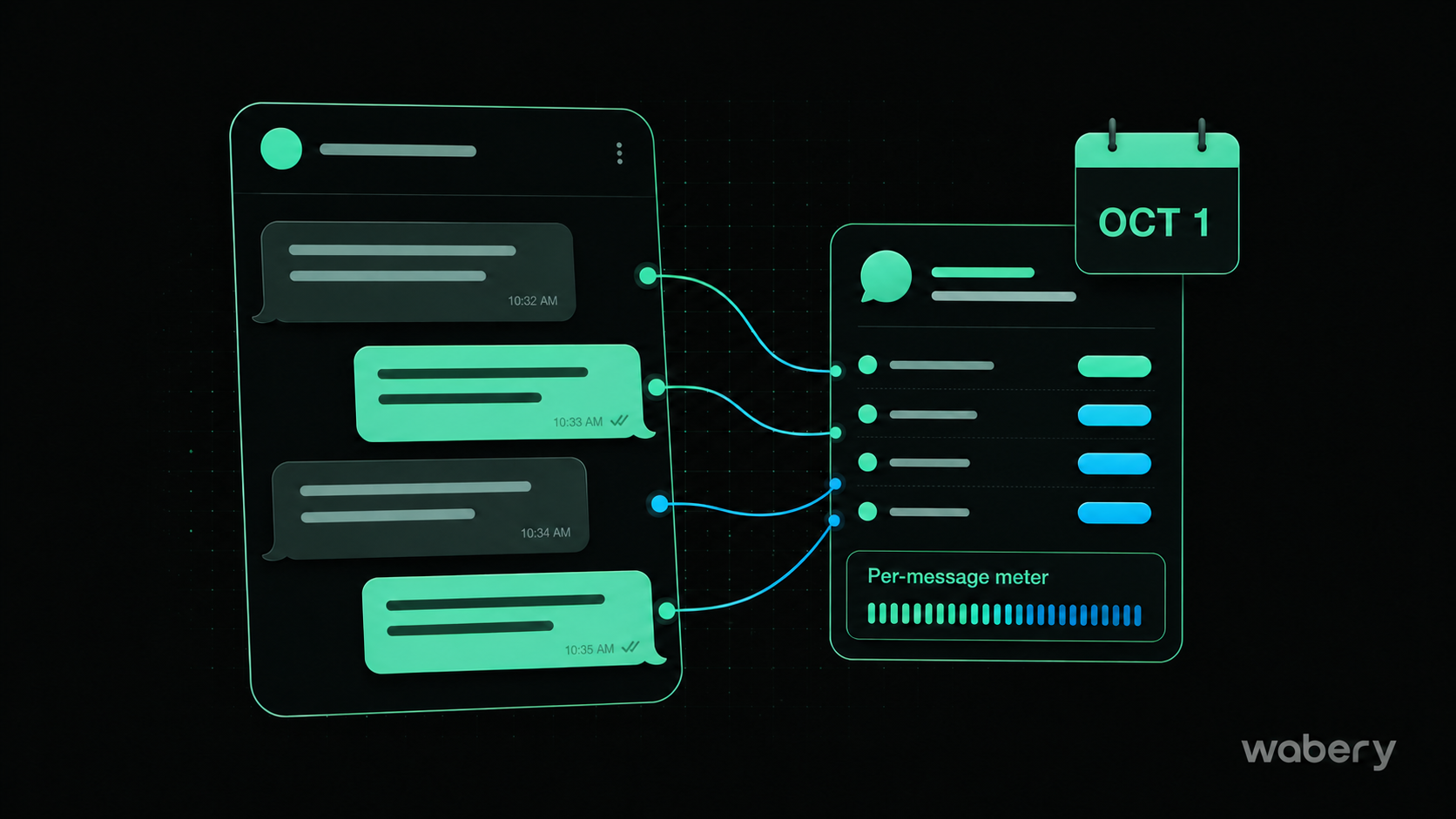
Meta published the October 1, 2026 rate card on September 1. The numbers are now real. Service messages become billable after the first 1,000 per phone number each calendar month. Your WhatsApp Business Account (WABA) can still deliver that free allowance without a payment method.
Want to know how much you’ll pay in your market? Check the full October 1 rate card here.
The short version
- Service messages and utility templates inside the 24-hour customer service window become billable on October 1.
- You get 1,000 free service messages per phone number per month. After that, Meta charges per delivered message based on the recipient’s market.
- A missing payment method alone does not stop service messages on October 1. You can still use the free allowance. Once it is used, service-message delivery stops without a valid payment method.
- Meta bills you directly. Wabery adds no markup on delivery.
What actually changes on October 1
Two things.
Service messages become billable. A service message is any non-template reply you send inside the 24-hour customer service window: written by a human, by an automation, or by a third-party AI. These have never carried a Meta messaging fee. From October 1 they are billed per delivered message.
Utility templates inside the window become billable too. They have been free inside an open 24-hour window since July 1, 2025. That exemption ends.
Two things that do not change: marketing, utility outside the window, and authentication templates keep the pricing they have today, and the 72-hour free entry point window still delivers messages for free.
Pricing detail that matters: the service rate in a market equals that market’s utility and authentication list rate, and service messages get no volume tiers. If you have negotiated volume pricing, it does not apply here.
The 1,000 free service messages rule
Meta gives every business phone number 1,000 free service messages per calendar month, including accounts without a payment method. Billing starts at the 1,001st. Without a valid payment method, service-message delivery stops after that number uses its free allowance. Nothing rolls over. Other account restrictions can still prevent delivery before the allowance is used.
Read that as per phone number, not per WABA. If you run one WABA with six live numbers across six clients, that is 6,000 free service messages a month, not 1,000. For agencies this is the single most useful line in the update: a small client on their own number may never pay Meta a cent for service traffic.
The allowance is also worth very different amounts depending on where your customers are. In Colombia, 1,000 free service messages is worth $0.80 a month. In Germany the same 1,000 messages is worth $55.00. Same rule, same 1,000 messages, about 69 times the value.
Add a payment method before you use the free allowance
You do not need a payment method to deliver the first 1,000 service messages per phone number each calendar month. A missing payment method alone does not cause an October 1 shutdown. After that allowance is used, Meta stops delivering service messages unless your account has a valid payment method.
If you expect to send more than 1,000 service messages on a number, set up billing before it reaches that limit so your replies can continue. Paid templates have their own billing requirements; this free allowance applies to service messages.
- Open each live WABA in WhatsApp Manager and check its billing settings.
- Add or update its payment method, check that it has not expired, and resolve any outstanding balance.
- Agencies: check each client’s connected WABA, including older accounts.
- Allow time to resolve any billing issue before a number uses its monthly free allowance.
The rates
Below is the complete October 1, 2026 USD rate card, taken from the rates spreadsheet Meta publishes on its pricing page. Every market, no excerpting. Each number is the price per delivered message. Meta’s file does carry its own Service column, and we checked it row by row: the service rate is identical to the utility and authentication rate in all 47 markets, with no exceptions. So one column below covers all three.
| Market | Marketing | Utility / Auth / Service | Auth-intl |
|---|---|---|---|
| ArgentinaYour market | $0.0618 | $0.0260 | n/a |
| BangladeshYour market | $0.0732 | $0.0037 | $0.0960 |
| BrazilYour market | $0.0625 | $0.0068 | n/a |
| ChileYour market | $0.0889 | $0.0200 | n/a |
| ColombiaYour market | $0.0125 | $0.0008 | n/a |
| EgyptYour market | $0.0644 | $0.0036 | $0.0650 |
| FranceYour market | $0.0859 | $0.0300 | n/a |
| GermanyYour market | $0.1365 | $0.0550 | n/a |
| Hong KongYour market | $0.0732 | $0.0260 | n/a |
| HungaryYour market | $0.0860 | $0.0350 | n/a |
| IndiaYour market | $0.0118 | $0.0014 | $0.0304 |
| IndonesiaYour market | $0.0411 | $0.0250 | $0.1360 |
| IraqYour market | $0.0341 | $0.0079 | $0.1280 |
| IsraelYour market | $0.0353 | $0.0053 | n/a |
| ItalyYour market | $0.0795 | $0.0300 | n/a |
| KazakhstanYour market | $0.0604 | $0.0180 | $0.1600 |
| KuwaitYour market | $0.0792 | $0.0440 | $0.1200 |
| MalaysiaYour market | $0.0860 | $0.0140 | $0.0418 |
| MexicoYour market | $0.0397 | $0.0085 | n/a |
| MoroccoYour market | $0.0414 | $0.0230 | $0.0811 |
| NetherlandsYour market | $0.1597 | $0.0500 | n/a |
| NepalYour market | $0.0732 | $0.0034 | $0.1120 |
| NigeriaYour market | $0.0516 | $0.0067 | $0.0750 |
| OmanYour market | $0.0341 | $0.0247 | $0.0600 |
| PakistanYour market | $0.0473 | $0.0150 | $0.0750 |
| PeruYour market | $0.0703 | $0.0300 | n/a |
| PolandYour market | $0.0366 | $0.0122 | n/a |
| QatarYour market | $0.0341 | $0.0120 | n/a |
| RomaniaYour market | $0.0860 | $0.0290 | n/a |
| RussiaYour market | $0.0802 | $0.0400 | n/a |
| Saudi ArabiaYour market | $0.0576 | $0.0107 | $0.0598 |
| SingaporeYour market | $0.0732 | $0.0160 | n/a |
| South AfricaYour market | $0.0379 | $0.0095 | $0.0200 |
| SpainYour market | $0.0707 | $0.0200 | n/a |
| Sri LankaYour market | $0.0732 | $0.0020 | $0.1440 |
| TurkeyYour market | $0.0109 | $0.0009 | n/a |
| UkraineYour market | $0.0860 | $0.0298 | $0.0746 |
| United Arab EmiratesYour market | $0.0576 | $0.0157 | $0.0510 |
| United KingdomYour market | $0.0635 | $0.0220 | n/a |
| North AmericaYour market | $0.0250 | $0.0034 | n/a |
| Rest of AfricaYour market | $0.0225 | $0.0040 | n/a |
| Rest of Asia PacificYour market | $0.0842 | $0.0113 | n/a |
| Rest of Central & Eastern EuropeYour market | $0.0860 | $0.0212 | n/a |
| Rest of Latin AmericaYour market | $0.0740 | $0.0113 | n/a |
| Rest of Middle EastYour market | $0.0392 | $0.0091 | n/a |
| Rest of Western EuropeYour market | $0.0592 | $0.0171 | n/a |
| OtherYour market | $0.0604 | $0.0077 | n/a |
The spread is the thing to notice. Service runs from $0.0008 in Colombia to $0.0550 in Germany, close to 69 to 1. Where you sit in that range decides whether service traffic is a rounding error in your cost model or the largest line in it, so the answer is genuinely different for every account. Run your own numbers rather than borrowing anyone’s example.
One clarification, because a lot of coverage is getting this wrong: most of those numbers are not an October 1 hike. Comparing the new card against the July 1, 2026 card, only three markets have a higher utility, authentication and service rate: Pakistan $0.0100 to $0.0150, Peru $0.0200 to $0.0300, South Africa $0.0076 to $0.0095. Everything else in that column is unchanged. What is new is that service, previously $0 everywhere, now fills in at the utility rate.
Five markets did raise marketing rates: Mexico $0.0305 to $0.0397, Saudi Arabia $0.0501 to $0.0576, the United Arab Emirates $0.0499 to $0.0576, Rest of Asia Pacific $0.0732 to $0.0842, and Rest of Middle East $0.0341 to $0.0392.
Nine markets are also new as standalone entries, carved out of the regional buckets they used to fall into: Bangladesh, Iraq, Kazakhstan, Kuwait, Morocco, Nepal, Oman, Sri Lanka and Ukraine. If you send to any of those, check your number against the new row rather than the regional one you used to use.
Meta prices by market, not by country
Worth clearing up, because it trips people up when they go looking for “the rate for my country”: Meta does not publish a separate price for every country on earth. It publishes 47 markets, which is why the table above is the whole card and not an excerpt. Thirty-nine are single countries, seven are regional buckets, and everything that falls into none of them bills at “Other”.
So the first thing to work out is not your customer’s country, it is which row their phone number lands on. A Vietnamese number bills at Rest of Asia Pacific. A Kenyan number bills at Rest of Africa. A Portuguese number bills at Rest of Western Europe. A Bangladeshi number used to bill at Rest of Asia Pacific and now has its own row.
Eighteen markets also carry a separate, usually much higher authentication-international rate: Bangladesh, Egypt, India, Indonesia, Iraq, Kazakhstan, Kuwait, Malaysia, Morocco, Nepal, Nigeria, Oman, Pakistan, Saudi Arabia, South Africa, Sri Lanka, Ukraine and the United Arab Emirates. That column only applies to authentication templates sent from outside the market, so it does not touch your service traffic, but it is easy to under-budget if you send OTPs across borders.
The same per-country list, mapped to these markets and searchable, is on our WhatsApp pricing page.
Service messages and Meta Business Agent are two different bills
These get conflated constantly, so: they are separate categories and a given reply is charged once, never twice.
Service message. Your system sends the reply. Human, automation, or your own AI. Billed per delivered message at the market’s utility rate, with 1,000 free per number per month.
Meta Business Agent. Meta’s own agent sends the reply. Live since August 1, 2026. Billed at $2.00 per 1M tokens, roughly 4 to 5 US cents per reply, with AI and delivery bundled into one charge. It also charges tokens inside the 72-hour free entry point window, where a service message would have been free.
The mouths are alternatives to each other, so the bills are alternatives too. Whichever one answers is the one you pay for. A reply is never charged twice.
We are not going to tell you to turn Meta’s agent off. It is a legitimate option, and for a business that wants a generic responder with no build, it is a reasonable one. Do the arithmetic instead:
- A Wabery reply costs your Wabery AI usage + your market’s service rate to Meta, anywhere from $0.0008 to $0.0550 depending on the row, with the first 1,000 service messages on that number free.
- A Meta Business Agent reply costs about 4 to 5 cents, all in.
So the comparison is real but conditional. Cheap AI plus the Meta delivery fee undercuts Meta Business Agent comfortably. Expensive AI plus a 2.5 cent delivery fee does not. The higher your market’s service rate, the less headroom your model choice has.
This is why Wabery’s default is not “send everything to a model.” Every reply you can serve with an automation is a reply with no AI cost attached at all: you pay Meta’s delivery fee and nothing else. Menus, business hours, booking confirmations, order status, opening a Flow, routing to a human. Use the model where reasoning actually earns its keep, and you land well under the Meta Business Agent per-reply number even in the expensive markets.
What this means for your Wabery agent
Wabery runs a hosted WhatsApp agent for customer questions, leads, and reservations, with an inbox for your team. You can set it up yourself. Budget for the plan, AI replies, and WhatsApp delivery separately.
The Meta delivery fee is now a real line in your cost model. Support and service traffic used to be free and it is not any more. If you quote clients per conversation, reprice it.
Wabery adds no markup on Meta delivery. For your dedicated WhatsApp Business Account, Meta bills you directly and the Wabery wallet is not involved. The shared Wabery sandbox is different: Wabery pays Meta for that shared number and, from October 1, deducts the destination market’s published service rate from the testing organization’s wallet. New accounts get $1 of wallet credit without a card. The first wallet top-up of $10 or more adds $2 bonus credit. You can use wallet credit for sandbox tests and Wabery-hosted AI.
Rebuild your per-reply model per market. One blended global number will lie to you now that the service rates span nearly 69 to 1. Split by destination.
Count the free allowance per number. A dedicated number receives its own 1,000-message allowance. The shared sandbox’s allowance belongs to Wabery’s shared number; it is an internal buffer, not a free per-customer sandbox quota.
Do not use the public calculator on whatsappbusiness.com. As of today it is still showing the July 1 card with service at $0. It will tell you your support traffic is free. It is not. Use the developer documentation instead.
The sources
Two pages, both from Meta, both authoritative. Partner blogs and the public calculator are not:
- WhatsApp Business Platform pricing: rate cards effective October 1, 2026
- Non-template messages pricing
Frequently Asked Questions
How much does a WhatsApp service message cost?
The service rate equals the utility and authentication list rate for that market, across all 47 markets on Meta's October 1, 2026 card. It ranges from $0.0008 in Colombia to $0.0550 in Germany. Examples: Brazil $0.0068, India $0.0014, Indonesia $0.0250, North America $0.0034, United Kingdom $0.0220. Service messages receive no volume tier discounts.
Can I send service messages without a payment method after October 1?
Yes. A missing payment method alone does not prevent delivery of the first 1,000 service messages per phone number each calendar month. Once a number uses that free allowance, service-message delivery stops without a valid payment method. Other account restrictions can still prevent delivery.
Is a Meta Business Agent reply also charged as a service message?
No. They are separate categories and a message is charged once. Meta Business Agent has been billed since August 1, 2026 at $2.00 per 1M tokens, roughly 4 to 5 US cents per reply with AI and delivery bundled. A service message is billed at the market's utility rate.
Did WhatsApp list rates go up on October 1, 2026?
Mostly no. Compared with the July 1, 2026 card, only three markets have a higher utility, authentication and service rate: Pakistan $0.0100 to $0.0150, Peru $0.0200 to $0.0300 and South Africa $0.0076 to $0.0095. Five markets raised marketing rates: Mexico, Saudi Arabia, the United Arab Emirates, Rest of Asia Pacific and Rest of Middle East. What actually changed is that service messages, previously free everywhere, are now billed at each market's utility rate.
Can I use the WhatsApp pricing calculator to estimate this?
Not yet. The public calculator on whatsappbusiness.com is still showing the July 1 rate card with service messages at $0. Use Meta's developer pricing documentation for the October 1 rates.
Does Wabery mark up Meta's message fees?
No. For your dedicated WhatsApp Business Account, Meta bills you directly at its published rates and the Wabery wallet is not involved. For Wabery's shared sandbox, Wabery pays Meta and, from October 1, deducts the same published destination-market service rate from the testing organization's wallet without markup. The shared number's 1,000-message allowance is not a free per-customer quota.
Related reading:
- Meta Will Charge for WhatsApp Service Messages from October 1, 2026
- The WhatsApp 24-Hour Messaging Window, Explained
- Meta Business Agent vs Wabery
All 47 rows above were taken from the USD rates spreadsheet linked under “Rate cards effective October 1, 2026” on Meta’s pricing page, retrieved September 1, 2026. Meta’s own file carries the note that it is not the current rate card and reflects future rates. If you are reading this after October 1, it is the current one.
— Claire
Questions or feedback? Reach out anytime