
How to Build WhatsApp Lead Qualification Without Hiring an SDR
A sales development rep is a serious annual investment, and most small teams can't justify one. Here's how to build a clean, consistent, around-the-clock WhatsApp lead qualification flow yourself, on top of a messaging API, without adding a person to payroll.
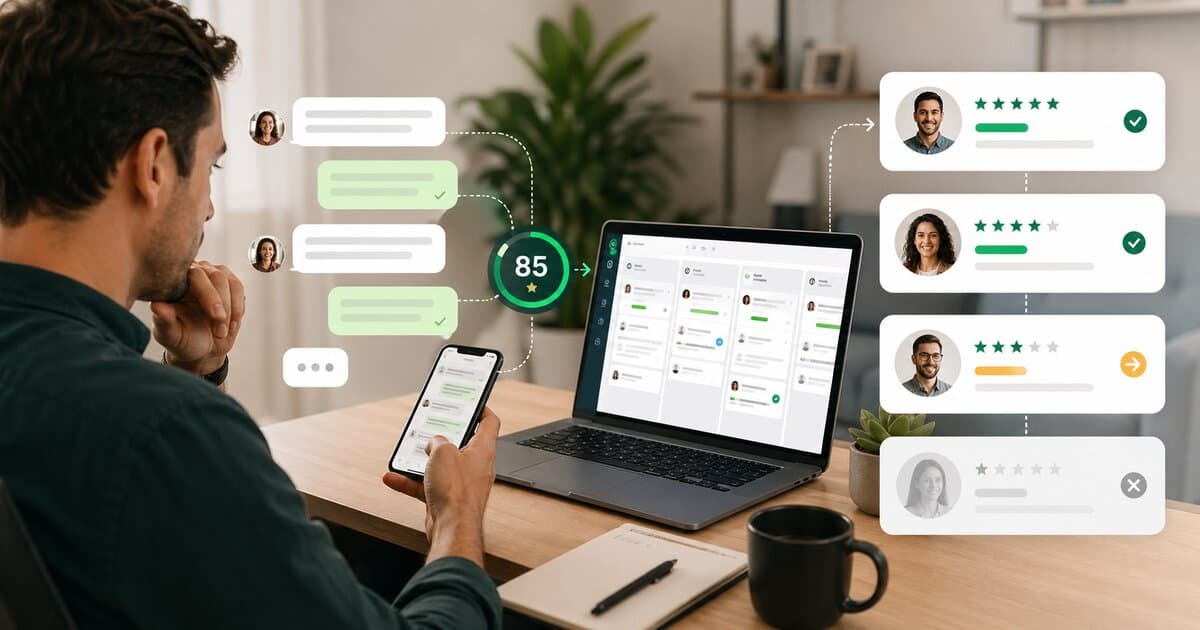
The first time most teams think about hiring a sales development rep is the moment their inbox stops being manageable. It happens in waves. A few inquiries a week becomes a few a day, then a few an hour, and suddenly you're answering "Hi, do you have availability?" at 11 PM from your couch instead of having dinner.
The traditional answer is: hire someone. A sales development rep, or SDR, is the person whose job is to sit on top of inbound inquiries, ask the right questions, figure out who's serious, and pass the qualified ones to the closer.
There's another answer, especially if you're technical: build the qualification step yourself. The SDR's job is, at its core, a structured data-collection and routing problem, and that's exactly the kind of thing you can stand up in an afternoon on a messaging API. Let's break down both options.
What an SDR Actually Does
Before you replace something, it's worth being precise about what it does. Strip away the buzzwords and an SDR's job comes down to four things:
- Respond fast to every inbound lead, every time, no matter what time it comes in.
- Ask the same set of qualifying questions to figure out fit, intent, and timing.
- Capture the answers in a place the team can see them later.
- Hand off the qualified leads to whoever closes them, with enough context that the closer doesn't have to repeat the conversation.
Notice what's not on that list. Closing the deal isn't usually the SDR's job. Negotiation isn't. Pricing pushback isn't. Those are closer tasks. The SDR's only job is to filter and tee up.
If you're hiring a person to do those four things and only those four things, you're paying a lot for what is, in practice, a high-consistency, high-volume routing job. Routing jobs are exactly the kind of work you can express as code, especially when the conversation happens in a structured channel like WhatsApp.
The Real Cost of an SDR
The salary number is the part most people focus on, but it's only part of the picture. A US-based SDR in 2026 typically costs:
- Base salary in the mid-five-figures, often plus a small commission
- Benefits, taxes, and overhead that add roughly 25 to 35 percent on top of base
- Recruiting and onboarding (job ads, time spent interviewing, training materials)
- A ramp-up period of one to three months before they're productive
- Tooling: a CRM seat, a phone system, a messaging tool, training resources
- The opportunity cost of your time managing them
For a small team doing a few hundred thousand in revenue, this is a serious annual commitment. Some can absolutely justify it. Many can't, especially when the work is uneven (busy seasons and quiet ones). And for businesses where the inbound is mostly off-hours, the math gets even worse: an SDR working 9 to 5 misses the leads that come in at 9 PM.
That's the gap a small amount of code can fill. Not by being smarter than a person. By being available, consistent, and dedicated to the four-step routing job above, and by living inside infrastructure you control.
The Anatomy of a Good Qualification Conversation
Let's get concrete. Here's what a clean qualification conversation looks like in WhatsApp, regardless of who or what is running it:
Customer: Hi, I saw your ad. Looking for help with my home renovation.
Business: Hey, glad you reached out. To make sure we're a good fit, mind if I ask a few quick things? What part of the project are you focused on right now (kitchen, bathroom, full house, something else)?
Customer: Kitchen mostly. Maybe a bathroom too.
Business: Got it. Do you already have designs or contractors involved, or are you starting from scratch?
Customer: Starting from scratch.
Business: Makes sense. What's your rough timeline, are you hoping to start in the next month or so, or planning ahead for later in the year?
Customer: Next month if possible.
Business: Got it. Last one: what part of the city are you in? We cover most of the metro area, just want to make sure we can serve you.
Customer: I'm in [neighborhood].
Business: Perfect, we work there often. I'm flagging this for our project lead. They'll reach out shortly with some next steps.
That's it. Five questions. Maybe two minutes of conversation. By the end, you know the scope (kitchen + maybe bathroom), the starting state (greenfield, no designs yet), the timing (next month), and the location (in your service area).
And the customer hasn't been asked anything pointless. Just the things that actually matter for figuring out if this is a real lead.
That's the qualification job. An SDR does it well. A WhatsApp Flow does it well too, because a Flow is literally a structured, in-chat form: each question is a field, each answer is typed data, and the completed submission lands in your backend as clean JSON. A 47-field intake form on your website does not.
Why WhatsApp Is the Right Channel
A lot of teams are still trying to qualify leads through email or web forms, and wondering why the conversion rates are bad. The honest answer is that nobody wants to fill out a 12-field form anymore. They expect to message you the way they message everyone else in their life.
WhatsApp specifically has a few characteristics that make it ideal for lead qualification:
It's already on their phone. No app to download, no account to create, no password to forget. The friction to start a conversation is close to zero.
Messages get read. WhatsApp's open rates are dramatically higher than email's. If you reply, the customer will see it.
Conversations happen in real time. People expect responses in minutes, not hours. That's a problem if you're handling it manually. It's a feature if you have code running 24/7.
WhatsApp Flows give you real form fields inside the chat. Instead of free-text parsing, you can present dropdowns, date pickers, and multi-select questions natively in the conversation, and get back structured answers. (More on Flows below.)
The 24-hour window keeps things active. Inside the first 24 hours of a customer message, you can converse freely. That's plenty of time to qualify a lead and book a follow-up. (We wrote more about how the 24-hour rule works here.)
The combination of "everyone has it," "messages get read," and "expectations are real-time" is what makes WhatsApp the best inbound qualification channel most small teams have access to right now.
Building a Qualification System Yourself
If you're not going to hire someone, here's the skeleton of a system you can build, with the easy path on a messaging API noted at each step.
1. Write Down Your Qualification Questions
Sit with whoever currently handles inbound and write down the four to six questions you ask every prospect before deciding whether they're worth a real conversation. For most teams, those cover:
- Scope: What exactly are they looking for?
- Context: What's their current situation?
- Timing: When do they want this to happen?
- Location or fit: Are they someone you can serve?
- Budget (sometimes): Are they in your range?
- Decision-making: Are they the one making the call?
Keep it short. If your list is more than six questions, you're qualifying too aggressively for a first conversation. The goal isn't to know everything. It's to know enough.
These questions map one-to-one onto a WhatsApp Flow. Each becomes a field. With Wabery you define the Flow once and the platform renders it natively in WhatsApp:
{
  "screen": "QUALIFY",
  "fields": [
    { "name": "scope", "type": "Dropdown", "options": ["Kitchen", "Bathroom", "Full house", "Other"] },
    { "name": "starting_state", "type": "RadioButtons", "options": ["From scratch", "Have designs"] },
    { "name": "timeline", "type": "Dropdown", "options": ["This month", "This quarter", "Later"] },
    { "name": "neighborhood", "type": "TextInput" }
  ]
}
2. Decide Your Definition of "Qualified"
This is the step most teams skip. They ask questions, but they never explicitly say what answers make a lead worth pursuing.
Be specific. Write a one-sentence definition of a qualified lead. For example:
- "A qualified lead is someone in our metro area who needs work in the next 60 days and has a project budget over a defined floor."
- "A qualified lead is a homeowner with at least 3,000 square feet of property who's hoping to start within the next quarter."
Because the Flow answers arrive as structured data, this definition is just a function over those fields. A few lines in your webhook handler decide the lane:
function isQualified(answers: FlowAnswers): boolean {
  return SERVICE_AREAS.has(answers.neighborhood) && answers.timeline === "This month";
}
Without this definition, every lead looks the same and gets the same handling. That's the fastest way to overwhelm yourself.
3. Run the Routine Conversations Automatically
Once you know your questions and your definition of qualified, you let an automation handle the routine first round. On Wabery, you trigger the Flow on an inbound message, and when the customer submits it, Wabery delivers a signed webhook to your endpoint. Your code then either:
- Books a follow-up with you for the qualified leads, or
- Sends a polite "thanks, we'll be in touch" to the rest, or
- Escalates immediately if the lead is unusually high-intent (a returning customer, a referral, a big project)
// POST /webhooks/wabery — Flow submission
app.post("/webhooks/wabery", verifySignature, async (req, res) => {
  const { conversationId, answers } = req.body;
  if (isQualified(answers)) {
    await crm.createLead({ ...answers, priority: "high" });
    await wabery.messages.send(conversationId, "Thanks! Our project lead will reach out shortly.");
  } else {
    await wabery.messages.send(conversationId, "Thanks for reaching out, we'll be in touch.");
  }
  res.sendStatus(200);
});
The point is that you own this logic. It's a focused tool with a defined job, which is also what Meta's updated WhatsApp policy expects: clearly scoped automation, not a free-roaming bot.
4. Make the Handoff Clean
When a qualified lead comes through, the person closing the deal needs three things:
- The lead's contact info
- A short summary of what they're looking for
- The actual conversation, in case they want context
Anything more is overkill. Surface the summary somewhere central, like a CRM, a shared inbox, or a Slack channel, the destination your webhook already writes to. The closer should be able to glance at the lead, get the picture in 10 seconds, and send the right next message.
5. Review the Hits and Misses Weekly
Once a week, look at the leads that came through and ask two questions:
- Who got tagged as qualified but didn't close? That's a sign your qualification is too loose. Tighten the questions or the definition.
- Who got tagged as unqualified but later turned into a customer? That's a sign your qualification is too strict. Loosen up.
Because the whole thing is your code over structured data, tuning is a one-line change to isQualified or a field tweak in the Flow, then redeploy. Calibrate based on outcomes, not gut feel.
SDR vs. A System You Build: A Side-by-Side
| Dimension | SDR (human) | A flow you build on a messaging API |
|---|---|---|
| Coverage | Business hours, often 5 days | 24/7, every day |
| Response time | Minutes when at desk, slow off-hours | Seconds, always |
| Consistency | Varies by mood, fatigue, day | Same logic every conversation |
| Capacity | Dozens of conversations a day | Effectively unlimited |
| Setup time | Recruiting, hiring, weeks to months of ramp | An afternoon to a couple of days |
| Edge cases | Strong on judgment calls and rapport | Escalates to a human by design |
| Cost | Mid-five-figures annually plus overhead | Infrastructure cost, usually a fraction |
| Best at | Long-discovery B2B, complex deals, regulated industries | High-volume inbound, fast qualification, off-hours coverage |
| Worst at | Late nights, weekends, repetitive work | Reading nuanced situations, deep rapport-building |
Neither column is "better." They're better at different things. The things SDRs are worst at (late nights, repetitive routing, consistency at scale) are exactly what a few hundred lines of code on top of a Flow handle best. And vice versa.
When You Should Hire a Human
To be clear, this isn't a "never hire an SDR" post. There are situations where a human is the right call:
- High-touch B2B sales with long discovery conversations and serious six-figure decisions. Humans win there.
- Industries with regulatory requirements around how leads are handled. Compliance often forces humans into the loop.
- Brands where the SDR conversation is itself part of the experience. Some luxury services, some concierge brands. The conversation is the product.
But for the average team fielding 20 to 200 inbound leads a month, the math doesn't work. An SDR is overkill, and the leads are too time-sensitive to wait for "Monday at 9 AM."
How Wabery Helps You Build It
Wabery is the messaging API and platform you build this qualification flow on top of. It is not a done-for-you SDR; it gives you the primitives so you can stand up the four-step routing job yourself, fast.
A few things specifically worth knowing:
Native WhatsApp Flows. Define your qualifying questions as a Flow once, and Wabery renders the in-chat form natively across WhatsApp (and your inbox unifies Instagram and Messenger too). You get structured answers back, not free text you have to parse.
Signed event webhooks. Every inbound message and Flow submission hits your endpoint with a verifiable signature. Your code owns what "qualified" means and where the summary goes, no black box.
A unified channels API, plus a CLI and MCP server. Send and receive across channels from one API. Spin up a project from the CLI, and wire your automations to an MCP server if you're building with an AI agent in the loop. You write the qualification logic; Wabery handles the transport, the Flow rendering, and delivery.
Built for the 2026 platform rules. Because your automation has a clearly defined job and escalates to a human when needed, it stays inside what Meta's 2026 AI policy requires.
The closer is still you. The qualifier is just code you control instead of a salaried hire.
Wrapping Up
You don't need to hire your first SDR to qualify your inbound leads well. You need a clear set of questions, an honest definition of what "qualified" means for your business, and a structured way to run the first round, which you can build yourself on a messaging API in an afternoon.
If you can keep up with that manually, great. If you're starting to drown in inbound, the answer isn't "hold on a few more months and hope." It's a system you build once and own.
Hire the human when the human is genuinely needed. In the meantime, let the routine stuff run on rails you control.
Frequently Asked Questions
For high-volume inbound qualification, yes. The four-step SDR job (respond fast, ask qualifying questions, capture answers, hand off cleanly) is a structured data and routing problem you can build on a messaging API with a WhatsApp Flow plus a webhook handler. For long-discovery B2B sales or regulated industries, you still want a human. Most small teams fall into the first category.
Four to six is the sweet spot, covering scope, current context, timing, location or fit, and sometimes budget or decision-making authority. Map each one to a field in a WhatsApp Flow so the answers come back as structured data rather than free text you have to parse.
If you already know your questions and your definition of a qualified lead, building it on a platform like Wabery typically takes an afternoon: define the Flow fields, point a webhook at your endpoint, and write a small isQualified function. The harder part is writing down the questions and the qualified-lead definition, which most teams have never done explicitly.
Not if it's helpful and honest. Customers care about getting useful answers fast. A WhatsApp Flow with clear, native form fields feels low-friction, and most don't mind that the first round is automated, as long as a real person is reachable when needed.
A menu-driven chatbot is a rigid script that frustrates people who type instead of tap. A WhatsApp Flow is a native, structured in-chat form (dropdowns, date pickers, text fields) that returns clean data to your backend, so your own logic decides what happens next. You build and own that logic.
Build in an escalation path: when the answers don't fit your rules, hand off to a human and preserve full context so your team can pick up without re-asking the customer. On Wabery the webhook payload carries the conversation, so the handoff stays clean.
Questions or feedback? Reach out anytime