5 Messages Your Inbound Pipeline Should Send Automatically (And How to Build Them)
Most teams stop at "here's my booking link." Here are five automated messages that qualify leads, reduce no-shows, and bring back lapsed customers, plus how to build each one on a messaging API.
You've got a booking tool. Customers can pick a time and confirm. Great start.
But if your workflow is only "get DM, send booking link, cross fingers," you're leaving serious money on the table. The most effective inbound setups run a whole sequence of automated messages, from first inquiry to long after the visit, that qualify leads, reduce no-shows, and turn one-time customers into regulars.
The good news: none of this needs a packaged product that does it "for you." Each of these messages is something you can build yourself in an afternoon on a messaging API, with a WhatsApp Flow to collect data and a webhook to wire it into your stack. Here are the five, with examples you can steal and notes on how to build each one.
1. The First-Touch Qualifier
When: Instantly, as soon as a lead messages you on WhatsApp, Instagram, or Messenger
Why it matters: This is your single biggest leverage point. Answering the obvious questions and capturing 2-3 qualifying answers in the first minute decides whether that lead becomes a customer or a ghost.
What most setups send:
"Hi! Here's our booking link: [link]"
What you should send:
"Hey, thanks for reaching out! Happy to help. A couple of quick questions so I can point you in the right direction:
- Are you looking for [option A] or [option B]?
- What's your rough timeline?
- What's the best phone number to reach you on?"
The key elements:
- Friendly, conversational tone (not a form)
- 2-3 questions max, don't interrogate
- Captures phone number so you can follow up outside chat
- Signals a real business that cares before asking them to commit
How to build it: Trigger on the inbound message event from a unified channels API, then send a native WhatsApp Flow as the qualifier. The Flow renders an in-chat form (service type, timeline, phone), and when the lead submits it, you get a signed webhook with structured JSON. No free-text parsing required.
// Send a WhatsApp Flow as soon as a new conversation starts
app.post("/wabery/webhook", async (req, res) => {
  const event = verifyWaberySignature(req); // HMAC signature
  if (event.type === "message.received" && event.data.isNewConversation) {
    await wabery.flows.send({
      to: event.data.from,
      flowId: "lead-qualifier",
    });
  }
  res.sendStatus(200);
});
2. The Warm Handoff
When: Once the lead has submitted your qualifying Flow
Why it matters: You know what they want. Now you need to set the next step clearly so they don't cool off.
What most setups send: Nothing, or a generic "we'll be in touch."
What you should send:
"Perfect, based on what you've told me, you're a great fit for [service]. That typically runs around $X.
I'll flag this for our team and someone will reach out first thing tomorrow to find a time to chat. Talk soon!"
The key elements:
- Confirms they're a good fit (or redirects politely if not)
- Sets a ballpark price so there are no surprises
- Promises a specific next step with a specific timeframe
- Keeps momentum warm until a human jumps in
How to build it: Handle the flow.completed webhook. Write the structured answers to your CRM or database, then send the confirmation message back through the channels API. Branching ("great fit" vs "polite redirect") is just an if in your own code, where it belongs.
if (event.type === "flow.completed") {
  const { service, budget, phone } = event.data.responses;
  await crm.leads.create({ service, budget, phone });
  await wabery.messages.send({
    to: event.data.from,
    text: `Perfect, you're a great fit for ${service}. Someone will reach out tomorrow morning.`,
  });
}
3. The "Still Interested?" Nudge
When: 24 hours after a lead goes quiet mid-conversation
Why it matters: Leads get distracted. Life happens. A gentle nudge recovers a surprising percentage of them.
What most setups send: Nothing. The lead just sits there.
What you should send:
"Hey Sarah, just checking in, still interested in [service]? Happy to answer any questions or set up a time to talk when you're ready."
The key elements:
- Low pressure, no guilt
- Short and easy to reply to
- Gives them a clear out ("when you're ready")
- Keeps you top of mind without nagging
How to build it: When a conversation stalls, enqueue a delayed job (or a row with a nudge_at timestamp). A cron worker wakes up, checks whether the lead has replied since, and if not, fires one outbound message via the API. One nudge per stalled conversation is the sweet spot. Two is pushy. Three is annoying.
4. The Post-Visit Follow-Up
When: 2-4 hours after the customer was served
Why it matters: The window right after a good experience is your best shot at capturing a second engagement, a review, a referral, or a standing commitment to come back.
What most setups send: Nothing. Maybe a review request three days later.
What you should send:
"Thanks for coming in today, Sarah! Hope everything went great.
If you have a minute, we'd love a quick review, it really helps us out. And if you want, I can flag a rough time to get you back on the calendar so you don't have to think about it later."
The key elements:
- Genuine thank you, not transactional
- Specific, low-friction ask (review or next visit)
- Offers to handle the next step for them
- Personal and warm, not promotional
How to build it: Your booking tool already knows when an appointment ended. Have it (or a scheduled query against it) post to your endpoint, which schedules the follow-up to send 2-4 hours later through the channels API. People asked to rebook while the experience is fresh come back far more often than those who "call when they're ready."
5. The Winback Message
When: When a regular customer hasn't been in touch in longer than their typical interval
Why it matters: Acquiring new customers costs 5-7x more than retaining existing ones. A simple, personal nudge can reactivate a serious chunk of revenue.
What most setups send: Generic promotional emails that go to spam.
What you should send:
"Hi Sarah, it's been a while since we've seen you, hope everything's going well.
If you've been meaning to come back in, I'd love to find a time that works. Just reply and I'll help you out."
The key elements:
- Acknowledges the gap without guilt-tripping
- Offers an easy, conversational next step
- Personal tone
- Doesn't try to upsell
If you have history on file, you can get even more specific:
"Hi Sarah! It's been about 10 weeks since you were last in, a bit longer than your usual. Want me to help you find a good time to come back?"
How to build it: A nightly job queries your customer table for anyone past their usual interval and sends a templated outbound message via the API, personalized from the data you already store. The "10 weeks, longer than usual" version is just string interpolation over your own records.
Putting It All Together
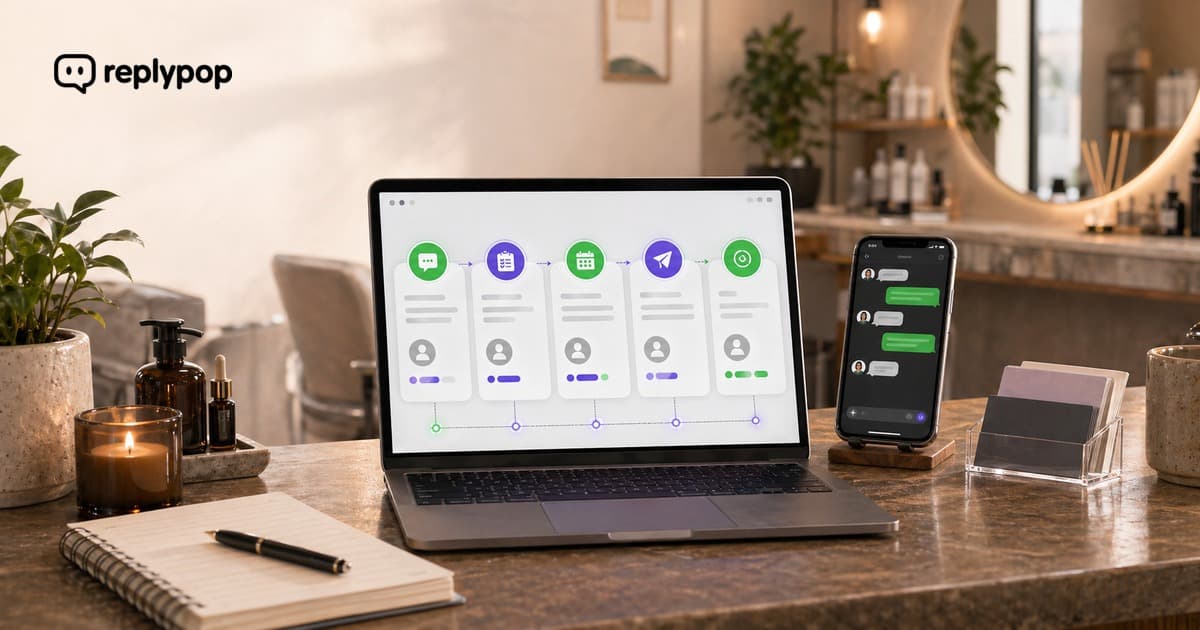
Here's what a well-designed inbound conversation pipeline looks like:
| Timing | Message | Goal |
|---|---|---|
| Inbound DM | First-touch qualifier (WhatsApp Flow) | Qualify the lead, capture phone, answer basics |
| Right after Flow submitted | Warm handoff | Set clear next step, hand to human team |
| +24 hours if stalled | "Still interested?" nudge | Recover stalled leads |
| 2-4 hours post-visit | Thank you + next-step offer | Capture rebooking or review while warm |
| Long interval passed | Winback message | Reactivate lapsed customers |
Five touchpoints, all automatic. Each one is a webhook handler, a cron job, and an API call, the kind of thing you can build and own yourself.
The Math: What These Messages Are Worth
Rough numbers:
First-touch qualification can lift conversion by 30-50%. If you get 30 inquiries a week and convert 20% today, qualifying properly gets you from 6 to 8-9 new clients a week. At $200 average value, that's $20,000-30,000/year in new revenue.
Stalled-lead nudges typically recover 10-20% of ghosts. If 10 leads stall per week, that's 1-2 saved every week, another $10,000-20,000/year.
Winback messages reactivate 5-15% of lapsed customers. If you have 100 drifted customers, even a 10% reactivation rate is 10 returning clients.
Combined, these automated messages can easily add $30,000+ in annual revenue while reducing your admin workload.
What You Need to Build This
To build the sequence above yourself, you need a few primitives:
- A unified channels API so one set of code sends and receives across WhatsApp, Instagram, and Messenger.
- Native WhatsApp Flows so the first-touch qualifier is a real in-chat form that returns structured data, not free text you have to parse.
- Signed event webhooks so
message.receivedandflow.completedevents land reliably in your stack. - A way to send scheduled/outbound messages for the nudge, post-visit, and winback steps, driven by your own cron jobs.
- A CLI and an MCP server if you want to configure from your terminal or wire your own AI model into the conversation.
How to Build It on Wabery
Wabery is the messaging API and platform that gives you exactly those primitives, so you build the lead conversation layer yourself, fast.
The channels API receives inbound messages and sends outbound ones across WhatsApp, Instagram, and Messenger with one interface.
Native WhatsApp Flows power the first-touch qualifier: you define the form, the customer fills it in-chat, and you get the answers as structured JSON.
Signed webhooks deliver message.received, flow.completed, and other events to your endpoint so you can write the routing, scoring, and handoff logic however you want, in your own code.
A CLI and an MCP server let you deploy from the terminal and connect your own AI agent if you'd rather have a model handle the back-and-forth.
Importantly, Wabery does not touch your booking software. Your Acuity, Calendly, Fresha, Booksy, or whatever else you use stays exactly as it is. Wabery is the messaging layer you build on; you keep full control of the scheduling and the logic.
All of this happens on WhatsApp, Instagram, and Messenger, where customers actually see and respond to messages. No app downloads, no spam folders.
Start Building Smarter Messages Today
Every day without these automated messages is revenue walking out the door. Ghosts you could have recovered. Regulars you could have brought back. Leads you could have qualified in 60 seconds.
The good news? With the right primitives, you can build the whole sequence in an afternoon.
Sign up free, connect a channel, and ship your first automated message today.
Want a head start on the build? Send us a message and we'll share example Flows and webhook handlers for your use case.
Questions or feedback? Reach out anytime
Continue Reading
Why Your Business Is Losing $15,000+ Per Year to No-Shows (And Where It Actually Starts)
No-shows cost businesses thousands every year. But most no-shows start earlier than you think, with customers who were never properly qualified. Here's how to build the fix yourself on a messaging API.
How to Choose Booking Software in 2026 (5-Minute Guide)
Stop overthinking. Answer 5 questions and you will know exactly which booking platform fits your business, plus how to build the messaging layer it leaves wide open.
What Customers Actually Think About AI Booking Assistants (And How to Build One They Trust)
Customers do not mind AI in the chat, as long as it is fast, accurate, and hands off to a human when it matters. Here is how to build an AI booking assistant they love on Wabery, while keeping the scheduler you already use.