
AI Agent vs Chatbot: What's the Difference (And How to Build the Agent Yourself)
Chatbots follow scripts. AI agents take action. Here's the real difference, and how to build an agent that understands intent, takes action, and runs on WhatsApp, Instagram, and Messenger using Wabery's API.
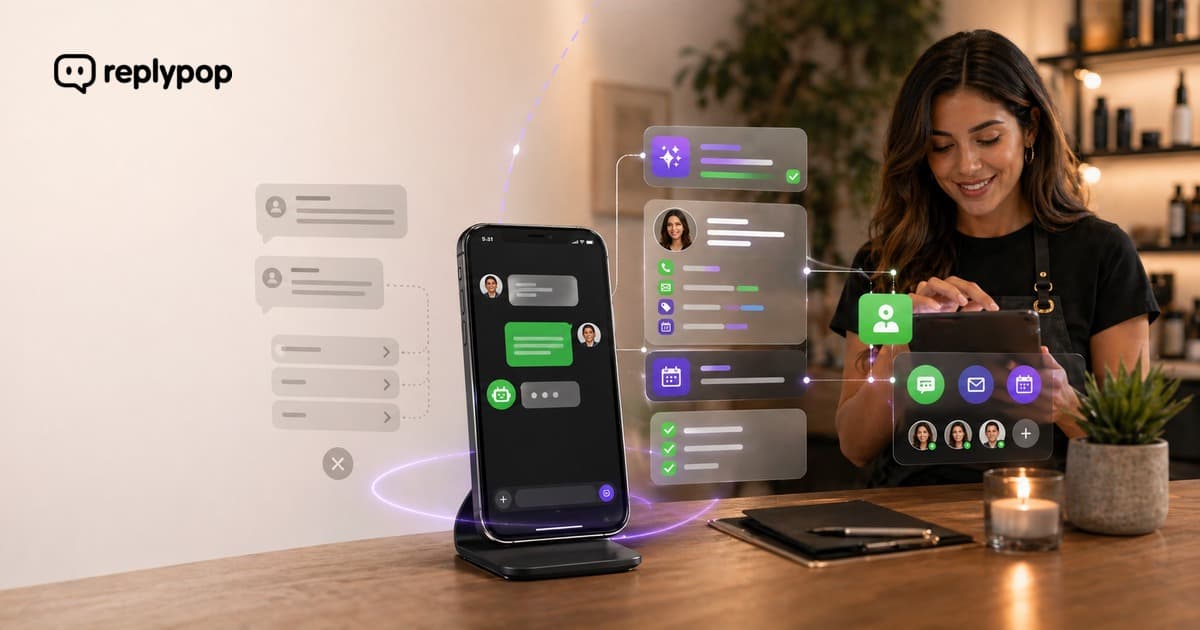
It's 9:47 PM on a Friday. A potential customer messages a business on WhatsApp:
"Hey, I'd like to book a deep tissue massage for tomorrow afternoon. Do you have anything available around 2 PM?"
Here's what happens if the business runs a scripted chatbot:
"Thanks for reaching out! Here are our services:
- Swedish Massage
- Deep Tissue Massage
- Hot Stone Massage
- Facial
Please type the number of your choice."
The customer types "2."
"Great! Please visit our booking page to schedule your appointment: www.example.com/book"
And just like that, the customer has to leave WhatsApp, open a browser, navigate a booking page, pick a time, enter their details, and hope they don't lose their place along the way.
Now here's what happens if the business runs an AI agent (something you can build yourself, in an afternoon, on top of a messaging API):
"I'd love to help. Deep tissue starts at $95 for 60 minutes. Let me grab a couple of details so the team can lock in tomorrow afternoon for you. What's the best number to reach you?"
The customer replies: "That works. It's 555-1234."
"Perfect. I've recorded your interest for tomorrow afternoon and sent the details to the team. They'll follow up with the best option shortly."
Same customer. Same question. Completely different experience.
One deflected the customer to a form. The other actually moved the lead forward, captured the data, and delivered it somewhere useful. That's the difference between a chatbot and an AI agent. And in 2026, that difference is mostly a matter of which primitives you build on.
Chatbots: The Old Playbook
Let's define what we're talking about. A chatbot is a software program that responds to user input based on predefined rules, decision trees, or keyword matching. Some newer chatbots use basic language models to understand phrasing, but at their core, they're reactive and limited.
Here's how a typical chatbot works:
It follows a script. Someone mapped out a decision tree: "If the customer says X, respond with Y." If the customer says something outside that tree, the chatbot either loops back to the beginning or spits out a generic fallback message.
It recognizes keywords, not intent. A chatbot might catch the word "book" and trigger a booking flow. But ask it "Can my husband and I come in together on Saturday?" and it has no idea what to do. There's no "husband" branch in the decision tree.
It can't take action. This is the big one. A chatbot can tell you about services. It can link you to a booking page. It can show you business hours. But it can't actually check availability, capture a structured lead, route data to a CRM, or trigger a downstream workflow. It's an information kiosk, not an assistant.
It breaks constantly. Ask a question it wasn't programmed for, and you get the dreaded loop: "I didn't understand that. Can you rephrase?" Three rounds of that and the customer is gone.
Chatbots had their moment. They were better than nothing back in 2018. But "better than nothing" is a low bar, and customers have figured that out. Research from Gartner shows that 64% of customers would prefer companies not use AI in customer service at all when the alternative is a bad chatbot experience. They're not anti-technology. They're anti-frustration.
AI Agents: The New Standard
An AI agent is fundamentally different from a chatbot. It's not following a script. It's pursuing a goal, and it has tools it can call to get there.
Here's what separates them:
It understands natural language. Not keywords. Not menu options. Actual sentences. "I want to bring my daughter for her first haircut, she's a bit nervous" isn't a problem for an AI agent. It understands the context, identifies the service (kids' haircut), notes the emotional context, and responds appropriately.
It reasons through multi-step tasks. An AI agent doesn't just answer one question and stop. It connects the dots: understand the intent, ask the right follow-up, capture the right details, and trigger the right next step, without forcing the customer into a form.
It takes real action. This is the defining feature. An agent has tools: it can collect a structured lead through an in-chat form, fire a webhook into your stack, write to your database, or hand off to a teammate. It doesn't just talk about doing things. It does them.
It handles the unexpected. When a customer says something the agent hasn't seen before, it doesn't crash. It reasons about the question, draws on the business context you gave it, and either answers or smoothly hands off. No loops. No "I didn't understand that."
It knows your business. You ground the agent in your specific services, pricing, availability rules, and policies. When someone asks "How much is a men's haircut?", it gives your price, not a Wikipedia answer, because you wired it to your own data.
The Comparison: Chatbot vs. AI Agent
Here's a side-by-side breakdown:
| Capability | Chatbot | AI Agent |
|---|---|---|
| Response style | Menu-driven, scripted | Natural conversation |
| Language understanding | Keywords and patterns | Full natural language |
| Handles unexpected questions | Fails or loops | Reasons and responds |
| Takes action | No, redirects to external tools | Yes, calls tools, captures data, fires webhooks |
| Multi-step tasks | One step at a time, manual | Chains actions autonomously |
| Integration | Static, manual updates | Live webhooks and APIs into your stack |
| Availability | 24/7, but limited usefulness | 24/7 with full capability |
| Customer experience | Frustrating for anything complex | Feels like messaging a capable person |
| How you build it | Build and maintain decision trees | Compose primitives: API, Flows, webhooks |
The gap isn't subtle. It's the difference between a vending machine and a concierge.
How You Actually Build an AI Agent
Here's the part most articles skip: an AI agent isn't a product you buy off a shelf and hope it fits. It's something you assemble from a few primitives. With a messaging platform like Wabery, you get those primitives directly:
- A unified channels API so one integration covers WhatsApp, Instagram DMs, and Messenger.
- Native WhatsApp Flows (in-chat forms) to collect structured data without bouncing the customer to a webpage.
- Signed event webhooks so every inbound message and form submission lands in your code, verified.
- A CLI and an MCP server so you can wire it into your own LLM, your CRM, and the rest of your stack.
A minimal "qualify a lead" agent looks like this. You receive the message, let your model decide whether to answer or collect details, and ship the result wherever you want:
// POST /webhooks/wabery — signed inbound message
app.post("/webhooks/wabery", verifySignature, async (req, res) => {
  const { conversationId, text, channel } = req.body;

  const reply = await runAgent({ text, channel }); // your LLM call

  if (reply.action === "collect") {
    // send a WhatsApp Flow (in-chat form) to capture the details
    await wabery.flows.send(conversationId, { flowId: "qualify_lead" });
  } else {
    await wabery.messages.send(conversationId, { text: reply.message });
  }

  res.sendStatus(200);
});
When the customer submits the Flow, you get another signed webhook with structured fields, and you push it wherever it belongs:
// POST /webhooks/wabery/flow — structured submission
app.post("/webhooks/wabery/flow", verifySignature, async (req, res) => {
  const { service, preferredTime, phone } = req.body.responses;
  await crm.leads.create({ service, preferredTime, phone, source: "whatsapp" });
  res.sendStatus(200);
});
That's the whole loop: understand, collect, deliver. You own the logic, the model, and the data. The platform handles the messaging plumbing.
Why This Matters for Conversational Businesses
If you sell products online, a chatbot that links to your product page might be fine. The customer can browse, add to cart, and check out on their own.
But conversations that need qualifying are different. Closing a lead isn't like buying a shirt. It requires:
- Understanding intent instead of keyword-matching
- Matching the right service to the customer's needs
- Capturing context before the customer disappears
- Collecting contact details for follow-up
- Routing data into the right system at the right moment
- Keeping the conversation warm while the team is busy
A scripted chatbot can't do that well. It can point customers to a booking page where they do it themselves. But that's not automation. That's delegation to the customer.
An agent you build handles the critical part inside the conversation. The customer never gets dumped into a dead-end flow. They ask, the agent qualifies, the data lands in your stack, and a warmer lead is ready to close.
The Same Booking Request: Chatbot vs. AI Agent
Let's walk through a realistic scenario. A customer messages a hair salon on Instagram at 8:30 PM:
"Hi, I'm looking to get highlights done. Probably a balayage. Do you do that? And what would it cost?"
How a Chatbot Handles It
Bot: Hi there! Welcome to Glow Salon. How can I help you today?
- Book an appointment
- View our services
- Hours & location
- Speak to someone
Customer: "I want to know about balayage pricing"
Bot: Here's a link to our full service menu: www.example.com/services
Would you like to book an appointment?
- Yes
- No
Customer: "Yes"
Bot: Please visit our online booking page: www.example.com/book
The customer clicks the link. The page loads slowly on mobile. There are 47 services listed. She scrolls, finds "Balayage," clicks it, but now needs to create an account. She sees the registration form, thinks "I'll do this later," and closes the tab.
She never books.
How an AI Agent Handles It
Agent: Hey! Yes, we absolutely do balayage. It's one of our most popular services. Pricing at Glow Salon depends on hair length:
- Short to medium: $180
- Long: $220
- Extra long: $250
The session typically takes about 2.5 to 3 hours. Want me to grab a couple of details so the team can prioritize you?
Customer: "Yeah, the $220 one. Saturday would be ideal."
Agent: Perfect. Saturday is one of our busiest days, so let me get the right context for the team. Do you prefer morning or afternoon? And what's the best number to reach you?
Customer: "Afternoon. 555-1234."
Agent: Got it. I've recorded a balayage request for Saturday afternoon and sent your details to the team so they can follow up fast.
Behind the scenes, that conversation triggered a WhatsApp Flow that captured { service: "balayage", length: "long", day: "Saturday", time: "afternoon", phone: "555-1234" }, fired a webhook, and created a lead in the salon's CRM. Same customer. Same intent. One conversation ended in nothing. The other ended with structured data in the right system. At 8:30 PM.
The Agentic Shift: Why 2026 Is the Turning Point
The term "agentic AI" has been buzzing around tech circles for the past year, but 2026 is when it's landing in real businesses in a tangible way. A few things are converging:
Large language models got reliable enough. Early models were impressive but unpredictable. They'd hallucinate facts, go off-topic, or give wildly inconsistent answers. The models available in 2026 are dramatically more stable. They follow instructions, stay on-topic, and handle edge cases gracefully. That reliability is what makes them usable in production, not just demos.
Tool use became a core capability. Modern AI models can call external systems: CRMs, inboxes, messaging APIs, and your own functions. This is what transforms a language model from "a thing that talks" to "a thing that acts." With an MCP server and signed webhooks, wiring those tools to a conversation is a small amount of code, not a research project.
Meta's WhatsApp policy validated the approach. When Meta drew a clearer line around general-purpose AI chatbots on WhatsApp Business in 2026, purpose-built business tools stayed firmly in. Appointment booking, customer support, order tracking, and payment collection are all explicitly allowed and encouraged. The platform is pushing builders toward focused, action-oriented AI rather than open-ended conversation, which is exactly what you get when you build the agent yourself against a real API.
Customer expectations shifted. People got used to AI that actually works. Voice assistants that control their smart homes. AI that summarizes their emails. When they message a business and get a clunky, menu-driven chatbot, it feels outdated. They expect the AI to just handle it.
McKinsey estimates that by the end of 2026, over 60% of customer interactions in service industries will involve some form of AI agent, up from roughly 30% in 2024. That's not a gradual shift. That's a wave.
Businesses still running script-based chatbots aren't just behind the curve. They're actively creating worse experiences than the ones who built real agents.
Where Wabery Fits
Wabery is the messaging platform you build the agent on. It's not a packaged "AI sales agent" we operate for you. It's the infrastructure layer: a unified channels API for WhatsApp, Instagram DMs, and Messenger; native WhatsApp Flows for in-chat data collection; signed event webhooks; automations; a CLI; and an MCP server. You bring the logic and the model. We handle the plumbing.
That distinction matters:
You own the agent. Your prompts, your model, your qualification rules, your data destinations. Nothing is locked in a black box you can't tune.
You ground it in your business. Your services, your pricing, your policies, fed to your model however you like. When a customer asks a question, they get your answer.
It runs where customers already are. No app to download, no booking page to visit. One API, three channels.
You ship fast. Flows for forms, webhooks for delivery, a CLI to test locally, an MCP server to plug into your AI tooling. The "build it yourself" path is genuinely an afternoon, not a quarter.
This isn't right for every situation. If you get five messages a week and handle them all personally, you don't need to build an agent. But if you're fielding dozens of inbound inquiries a day across multiple channels and want a system you fully control, the primitives are right here.
When Should You Build One?
If you're currently using a scripted chatbot (or no automation at all), here are the signs it's time to build a real agent:
You're losing leads after hours. If customers message at night or on weekends and don't hear back until the next business day, some of them are moving on. An agent responds in seconds, any time.
Your chatbot frustrates more than it helps. If you're getting complaints about your automated responses, or customers routinely skip the chatbot and call instead, the chatbot isn't serving its purpose.
Your team spends hours on repetitive conversations. "What time are you open?" "How much is X?" "Do you have availability on Saturday?" If staff answer the same questions 30 times a day, that's time an agent could reclaim.
You need the conversation to create momentum. If sending customers to an external page too early causes drop-off, capturing the data inside the chat will increase conversions.
You're scaling but can't scale your response time. More customers should mean more qualified leads, not more missed messages. An agent handles 1 conversation or 100 with the same speed and quality.
The Bottom Line
The chatbot era served its purpose. It showed businesses that automation was possible and that customers were willing to interact with software for simple tasks.
But "simple tasks" is all scripted chatbots ever managed. The moment a customer needed something slightly complex, the chatbot broke down, redirected to a human, or sent them to a different platform.
AI agents don't have that ceiling. They understand natural language. They take real action. They handle multi-step workflows from question to qualification to handoff, all inside a single conversation. And the best part: you build them yourself, on primitives that already exist, in far less time than you'd expect.
The question isn't really "chatbot or AI agent?" anymore. It's "what are you going to build first?"
Questions or feedback? Reach out anytime
Continue Reading
What Is an AI Booking Agent? The Complete Guide for Service Businesses
An AI booking agent is really a messaging layer in front of your scheduler. This guide shows what it does, what it shouldn't replace, and how to build your own on a messaging API like Wabery.
Why Builders Are Replacing Chatbots with AI Agents in 2026
60% of small businesses now use AI tools, and the smartest builders are ditching rigid chatbots for real AI agents. Here's what changed in 2026 and the messaging primitives you build them on.
Why 80% of People Hate Chatbots (And How to Build One They Don't)
Most customers hate chatbots because they're frustrating and unhelpful. Here's how to build messaging experiences on WhatsApp, Instagram and Messenger that customers actually thank you for.